You know the drill: you’ve started resistance training, and sooner or later you hear that the amount of protein you eat is key to achieving your goals. .
And that’s not entirely wrong. Protein is one of the most important inputs for muscle growth, recovery, and overall performance.
But here’s the issue:
Knowledge on protein intake is not the problem; executing on a daily basis is the issue.
Individuals struggle because committing to a nutrition plan most often clashes with the normal demands from real life and they have not developed the tools to support this change.
Simply knowing what to do doesn’t automatically create consistency. Time and time again, we see that long-term success breaks down not from a lack of information: but from a lack of practical skills and dependability.
As Jackie Hatchew, the Smith Performance Center dietitian, puts it:
“Most people don’t have a protein knowledge problem. They have a consistency problem. They undereat earlier in the day, try to make up for it later, and then wonder why recovery feels off.”
This article will walk you through protein intake, but more importantly, it will show why it often doesn’t work the way you expect: and what to do about it.
Address the Real Problems First
When a client walks into our facility, they often think they can reach their goals by simply increasing protein intake in their diet and drinking additional smoothies or shakes. That’s a quick fix aimed at one possible problem: low protein intake.
But most people are not actually struggling with a lack of protein knowledge.
They are struggling with fatigue, recovery, inflammation, body composition changes, or performance plateaus. Those are the real problems that need to be identified before taking a swing at a solution or “hack”.
If you find that eating more protein alone “isn’t helping”, it’s usually not a protein problem.
It’s a problem occurring in your system.
Common problems we see:
- Low overall calorie intake
- Poor meal timing (undereating earlier, overeating later)
- High training demands alongside low food intakes
- Digestive issues with certain foods or supplements
If you ignore this systematic approach, you will wrongly assume that everyone has the same protein needs and you will probably get the same ‘solutions’ that don’t actually result in progress, just short stints of change followed by a crash.
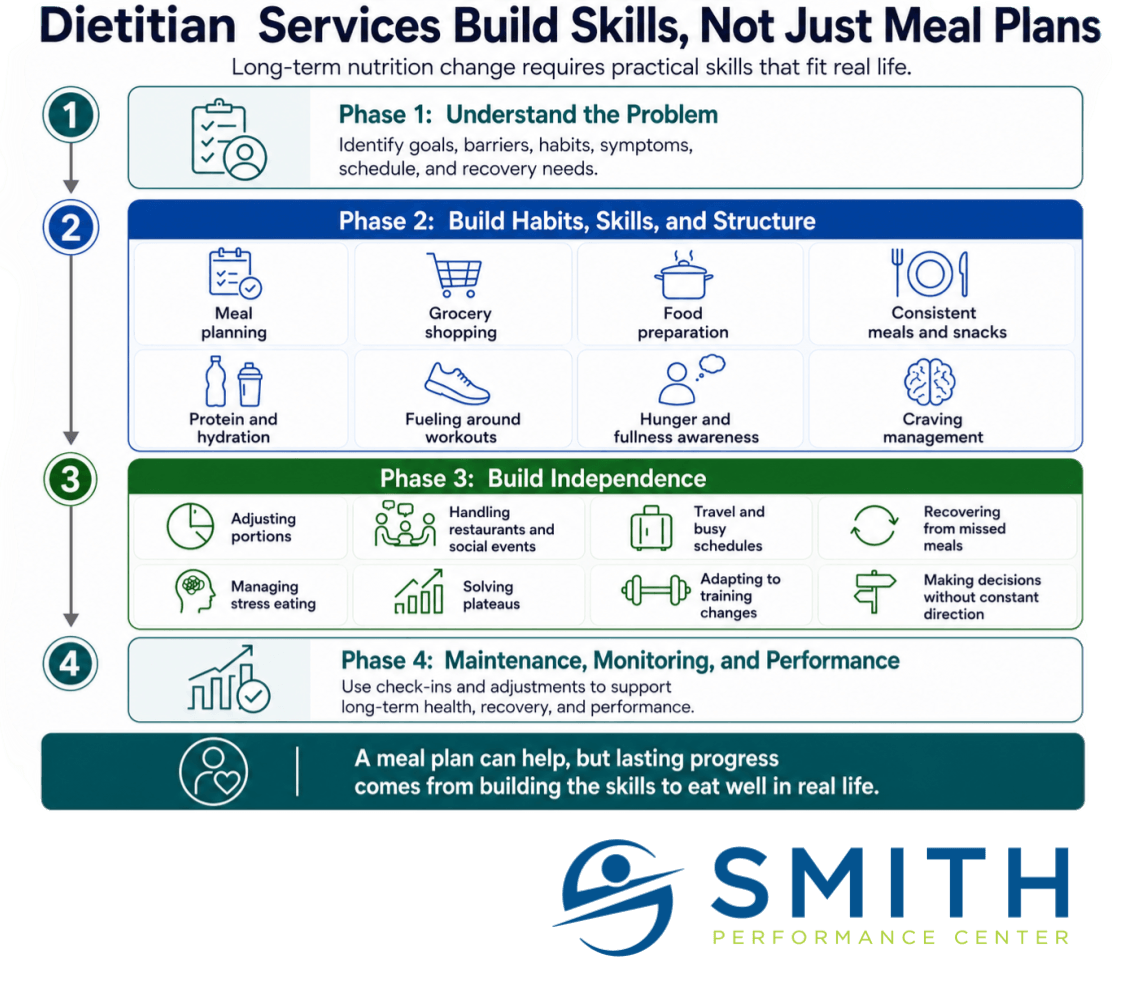
Our team uses a phase system to operationalize the process of problem solving. Problem number one is always to diagnose what is currently going on.
Our dietitian uses a phase based, problem solving process to get you in control. You can read more about it in our article “How a dietitian can help me? More than a Meal Plan.“
“If someone is hitting their protein target but still not recovering properly, we don’t focus solely on increasing protein,” Jackie says.
“We look at total intake, timing, and if there are any gaps in their fueling.”
We look at the individual’s specific problem and their unique goals.
A common problem we see in active adults is the training trap. The training trap typically begins by underfueling, which then leads to under performing during their activity, followed by trying to compensate by overtraining on their next session…which then often leads to further underfueling next time they train.
Watch this quick explanation of the training trap.
The training trap is a doom loop, which means that each step feeds into the next step in a cyclical process.
Therefore, we must break the loop.
We can start by increasing fueling or timing of protein intake, but this must also be accompanied by regulating the amount of training performed.
This is one of the places your plan matters.

This is the difference between information and application.
Protein doesn’t exist in isolation. It works within the system.
As you consider your protein intake, let’s go through our process to clarify the actual problem you need to address.
Energy Intake: The Hidden Layer
One of the biggest problems in nutrition advice is this generic obsession with protein. Most social media ‘influencers’ end their conversation at protein consumption.
Protein does matter a lot: but protein does not solve every nutrition problem.
The most common mistake we see is someone increasing protein while their total energy intake remains too low for their activity level.
This is especially common in active adults trying to:
- lose weight;
- improve body composition;
- maintain high training volume;
- “eat cleaner”;
And the result is very predictable:
- recovery worsens;
- fatigue increases;
- performance drops;
- soreness lingers;
- motivation declines;
And guess what happens next?
They often assume they need more protein, or another supplement, or more discipline … or even harder training.
You can see how the training trap sneaks in on people with the best intentions.
The reality is that their body does not have enough total energy coming in to support the energy going out during their activity.
As Jackie explains: “The body prioritizes the brain, heart, and nervous system before it will allocate energy to muscle tissue recovery. For people in a large caloric deficit, this often means there is not enough energy leftover to support muscle growth, regardless of the amount of protein consumed.”
This is the true reason as to why nutrition advice online fails.
It is hyperfocused on isolated variables instead of the whole system.
Surprisingly, anyone can technically hit their protein goal while:
- skipping meals;
- chronically under-eating;
- relying heavily on supplements;
- failing to match intake to training demand;
- relying on injections or medications to compensate for poor recovery habits;
And then they wonder why their body still feels terrible at the end of the day.
At SPC, we typically see energy intake problems show up as:
- chronic fatigue;
- stalled performance;
- recurring injuries;
- excessive soreness;
- inability to fully recover between exercise sessions;
For example, a common orthopedic lesion like bone stress injury comes back over and over again when individuals have low energy availability (i.e they are constantly under-eating). We can correct the biomechanical contributors, but the bone injury will inevitably come back once again if we do not address the overall amount of calories consumed on a daily basis.
Protein supports recovery, but recovery still requires the necessary energy.
Start Here: Consistency Beats Precision
Before talking about grams, sources, or timing, you need to understand this: consistency matters more than hitting a perfect number.
You can have the best protein target in the world, but if:
- you skip any meals
- your intake fluctuates wildly
- you rely on motivation instead of structure
This will never work.
“People overestimate how precise they need to be and underestimate how consistent they need to be,” Jackie explains.
Most nutrition plans fail because the implementation skills are not fully developed. Without these skills, you will struggle to stabilize your energy capacity and will have a hard time hitting your goals.
You will fail if your actions are not easily repeatable. Once again, this is not a knowledge issue: it is an execution issue.
Meal Structure: Where Most People Fix It Fast
If you want one actionable change, it’s this one:
Start earlier in the day.
- Breakfast: include protein;
- Lunch: include protein;
- Dinner: include protein;
Then consume high protein snacks as needed.
“If you miss protein early in the day, you’re playing catch-up later,” Jackie explains.
“That usually leads to inconsistency.”
This one minor change fixes more problems than any supplement ever will.
Watch our quick video on nutrition and protein.
Macronutrients: How much protein should I eat?
Once consistency and other major issues are defined, now the protein intake itself becomes more meaningful.
Macronutrients are food compounds needed in large amounts to provide energy to the body. The three macronutrients are carbohydrates, fat, and protein.
- Carbohydrates serve as the primary source of energy for the brain, muscle and nervous system.
- Fat provides long lasting energy, aiding in nutrient absorption and supporting hormone production.
- Protein is essential for immune function, as well as building and repairing tissues.
All three macronutrients are necessary for a balanced diet, however protein is the primary macronutrient required for muscle growth.
How Much Protein Do You Need?
A good target for resistance-trained individuals:
- 1.6–1.8 g/kg/day
- 0.73–0.82 g/lb/day
| Body Weight (lb) | Protein Range(grams) | |
| 100 | 73 g | 82 g |
| 110 | 80 g | 90 g |
| 120 | 88 g | 98 g |
| 130 | 95 g | 107 g |
| 140 | 102 g | 115 g |
| 150 | 110 g | 123 g |
| 160 | 117 g | 131 g |
| 170 | 124 g | 139 g |
| 180 | 131 g | 148 g |
| 190 | 139 g | 156 g |
| 200 | 146 g | 164 g |
| 210 | 153 g | 172 g |
| 220 | 161 g | 180 g |
| 230 | 168 g | 189 g |
| 240 | 175 g | 197 g |
| 250 | 183 g | 205 g |
This range supports both muscle repair and growth.
But here’s where people go wrong:
They treat this number like a switch. If you hit the protein number, then results magically happen.
That’s not how it works.
“Protein has to match the demand you’re placing on your body,” Jackie explains.
“If training increases but intake doesn’t, recovery will lag—even if the number looks right on paper.”
Protein supports the system. It doesn’t override it.
If you skip meals or have a low calorie intake, the amount of protein you eat will not properly work for muscle growth. Your body will continue to demand the necessary energy and will use the energy from the protein to sustain other systems of your body, like your brain or nervous system.
Protein Sources (Keep It Practical)
You have a lot of options:
- Meat, poultry, fish;
- Eggs and dairy;
- Legumes, tofu, plant-based options;
- Protein powders and bars;
The priority:
Get most of your intake from whole foods.
Use supplements to fill gaps.
But don’t overcomplicate this:
“Convenience matters more than people think,” Jackie says.
“If a protein shake helps someone consistently hit their intake, that’s a better strategy than relying on foods they won’t prepare.”
The goal isn’t for you to be perfect. The goal is for your protein intake to be easily repeatable in your daily routine.
Micronutrients: The Overlooked Layer
Most people skip this entirely.
But micronutrients play a key role in:
- energy production;
- recovery;
- tissue repair;
If your diet is:
- highly processed;
- lacking variety;
- low in fruits and vegetables;
You can hit your protein target and still underperform.
This is why whole foods matter.
Not because they’re “clean,” but because they support the system that protein depends on.
Supplementation: Last, Not First!
Supplements can help but they’re not the foundation.
Use them when:
- you can’t hit targets with food;
- you need convenience around training;
- you’re filling a clear gap;
“If someone relies entirely on supplements, there’s usually a bigger issue,” Jackie says.
“But when used correctly, they make consistency easier.”
If you’re starting with supplements before identifying your problem, building your eating habits and consistency, and improving your diet first, you’re skipping a lot of steps.”
Why Protein “Doesn’t Work” for Some People
And now this is where everything ties together.
When protein doesn’t seem to help, it’s usually because:
- intake isn’t consistent;
- total calories are too low;
- training demand is too high;
- recovery is inadequate;
Or some combination of all four.
That’s why people feel like they’re doing “everything right” but still not progressing.
They’re hyperfocusing on one variable in a multi-variable, complex system.
When a Dietitian Actually Becomes Valuable
Basic protein recommendations are easy.
Applying them to your busy schedule, your training, your recovery, your digestion : that’s the hardest part. Building skills and holding accountability is where most people falter.
“Protein recommendations are simple. Making them work in someone’s life is where the real value is,” Jackie explains.
This is where a dietitian changes everything for someone who wants to take their nutrition seriously.
Not by giving you more information: but by helping you build a system that actually works for you and for you only.
Do you understand the difference between a dietitian and a nutritionist? This is a question we often get asked and believe the answer actually matters. Learn more about the difference and how to determine which professional is best for you.
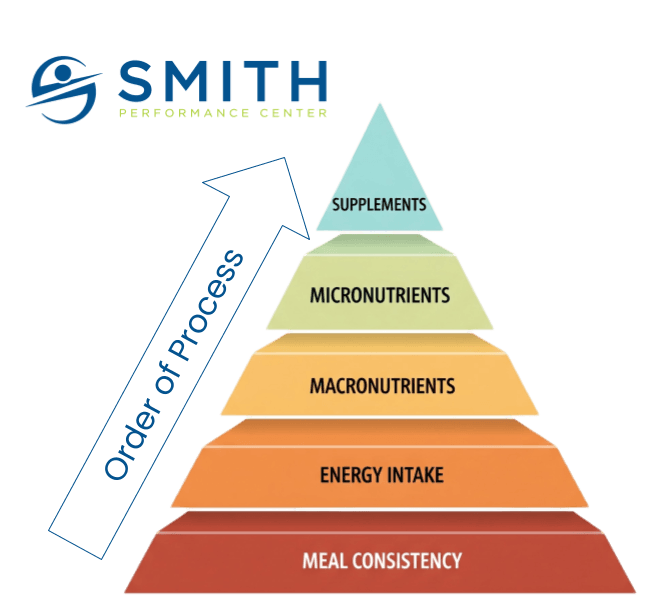
In conclusion: protein matters. But it’s not the starting point.
If you want it to actually work, think in this order:
- Problems – what’s actually limiting you?
- Consistency – can you do it repeatedly?
- Energy Intake – do you have the right amount of calories?
- Macronutrients – are you hitting targets?
- Micronutrients – is your system supported?
- Supplements – do you need them?
Most people jump straight to step six. That’s why they stay stuck.
But you don’t need to be like most people.
Raise the bar by following this system.
And really consider a dietitian to get your performance to the next level.
At Smith Performance Center, nutrition is no longer separate from rehab or training. Jackie Hatchew MS RDN works alongside our physical therapists and coaches to maximize your progress and your health goals.
If you’re training consistently but keep getting hurt or stuck or missing nutrition goals, this is the next place to look.
Learn more about our Dietitian Services or schedule a Nutritional Initial Evaluation.