Returning to sports as an adult often feels harder than it should.
You finally get back into basketball, volleyball, running, or lifting. Things go well for a few weeks or months. Then something breaks down. A knee flares up. The calf tightens. The shoulder starts barking. Eventually you stop again.
Then the cycle repeats.
Most people assume this happens because they are getting older or because their body is fragile. But the reality is usually much simpler.
Most people restart their sport without adjusting the standard they use for returning.
They return using the same assumptions they had when they were 21.
This episode of Past Your Prime breaks down why this happens and how to approach sports in a way that allows you to keep playing long-term instead of constantly restarting.
The “Big Three” Problems With Returning To Sports As An Adult
When adults try to return to sports, three problems show up again and again.
1. Injuries interrupt momentum
Most people do not quit sports because they lose interest.
They stop because something starts hurting and they never develop a clear strategy to manage it.
2. Expectations are unrealistic
Many people return expecting to perform at the level they once did without building the capacity required for it.
The body rarely tolerates that jump in load.
3. Life stress changes recovery
Training stress does not exist in isolation. Adults are managing:
- Work
- Family
- Sleep disruption
- Stress
- Travel
All of these affect recovery and tissue tolerance. Ignoring these factors makes injuries far more likely.
The Two Paths People Take When Returning to Sport
When people try to return to sports after an injury or long break, they typically fall into one of two paths.
Path 1: The Restart Cycle
This is the most common pattern.
It usually looks like this:
- Feel motivated and start training
- Build volume quickly
- Something starts to hurt or energy bottoms out
- Back off or stop completely
- Restart a few months later
Over time, the restart cycle becomes frustrating and discouraging.
Many people eventually conclude that their body “just can’t handle it anymore.”
In reality, the problem is usually load management and progression combined with a high starting physical capacity relative to energy and tissue capacity.
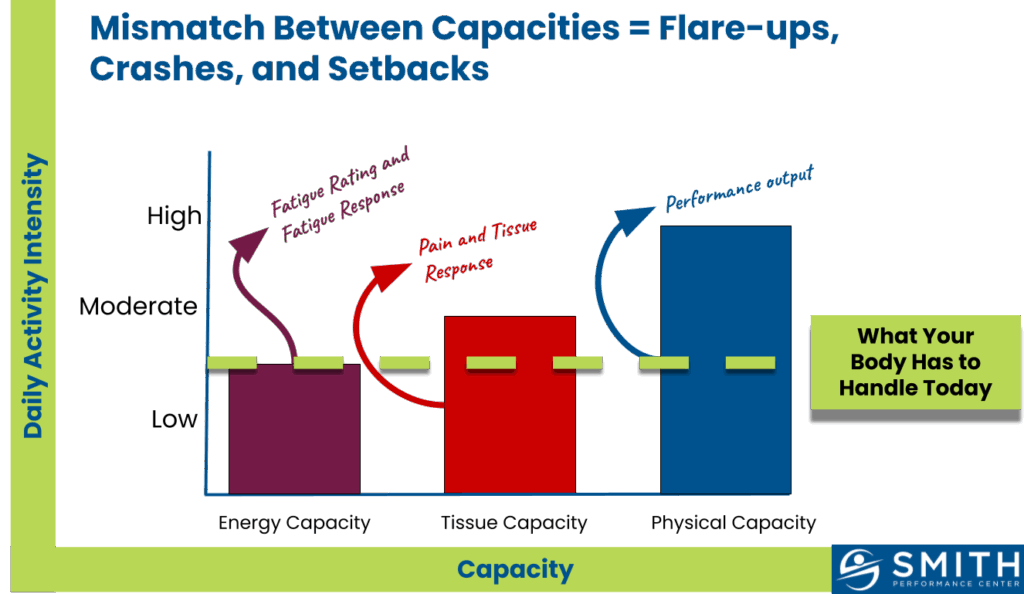
Mismatch between energy, tissue, and physical capacity often leads to flare-ups, fatigue, or setbacks — diagnosing which capacity is limiting progress, and identifying the specific cause, is the first step in rebuilding long-term health and performance.
Path 2: Capacity Building
The alternative is to return with a strategy focused on building capacity over time.
This means thinking about three key areas:
- Physical capacity – what you can do and how well you perform the sport. A long history with a sport means this is very high.
- Tissue capacity – how much load you can handle without getting hurt. If you have a long standing recurrent injury, this can be very low.
- Energy capacity – what your body can do sustainably based on calories, hormones, stress, sleep. The sport is not the only thing pulling on this.
Instead of jumping back to full intensity, the focus becomes gradual exposure and progression.
This approach allows the body to adapt rather than constantly react.
Physical Capacity vs Tissue Capacity
One of the biggest traps athletes fall into is confusing what they can do with what their body can tolerate.
These are not the same thing.
For example:
- Someone may be strong enough to play a full volleyball match.
- But their Achilles tendon may not yet tolerate that volume of jumping.
This mismatch creates the classic scenario where someone can perform the activity but pays for it later.
Understanding the difference between physical capacity and tissue capacity is critical for returning to sport successfully.
“There’s really two variables I look at. That’s the daily stresses on average what you’re having to handle. And then there’s the peak stresses. And your body has to be able to handle both of them.
Where I see with sport the bigger issue is people can’t handle the peak stresses.”
You can read more about how we address the rehab standard in our article, Tissue Capacity vs. Exercise Capacity: Why Most People Miss the Mark.
Managing Your “Body Inventory”
As athletes accumulate injuries over the years, they develop what we jokingly call a body inventory.
Most experienced athletes know their list:
- A knee that gets irritated with jumping
- A shoulder that flares with overhead work
- A calf that tightens during sprints
- A back that dislikes heavy lifting
Ignoring these issues rarely works.
Long-term athletes learn to manage their body inventory rather than pretend it does not exist.
That means adjusting:
- Training volume
- Exercise selection
- Warm-ups
- Recovery strategies
This is not a sign of weakness. It is a sign of experience.
The “Just One More Set” Problem
Another common trap in sports training is the urge to push just a little further.
The classic example is finishing a workout and thinking:
“Just one more set.”
In the moment, this feels harmless.
But when athletes are already near their tolerance threshold, that extra load can be the tipping point that leads to irritation or injury.
Consistency over time almost always beats occasional heroic workouts.
The Challenge of Novel Sports
Trying a new sport as an adult introduces another layer of difficulty.
Even if someone is generally fit, new sports create unfamiliar loading patterns.
Examples include:
- Pickleball for runners
- Volleyball for lifters
- Basketball for cyclists
These activities require specific coordination and tissue adaptation.
Without gradual exposure, even fit athletes can develop overuse injuries quickly.
The Longevity Mindset
The goal for most adult athletes is not peak performance for one season.
It is continuing to play for decades.
That requires a different mindset.
Instead of chasing short bursts of performance, successful athletes focus on:
- Sustainable training patterns
- Managing recovery
- Gradual capacity building
- Listening to early warning signals
The reward is simple.
You keep playing.
🎙️ About Past Your Prime Podcast
Past Your Prime is the podcast for active adults balancing training, rehab, family, and real life.
Hosted by Craig Smith (PT & SPC Founder) and Alex Keicher (professional athlete and working dad) and presented by Smith Performance Center.