Why Rehab Feels Like Chasing Injuries

Past Your Prime Podcast – Episode 51

Listen on:
Spotify | Apple | Youtube

Why does one thing finally start to feel better… and then something else decides to hurt?

It can feel like you’re chasing injuries. Like you calm one fire down and another pops up.

Is that bad rehab? Or is that actually how complex systems work?

In this episode of Past Your Prime, Craig introduces the concept of Layered Pathology, the idea that injuries build in layers, and when one layer improves, the next one becomes visible.


Injury Whack-A-Mole Is Usually Not a Mistake

When symptoms shift, most people assume either the plan failed, the provider missed something or the treatment caused damage.

But often what’s happening is more complex and often expected. You reduce stress on one tissue. Force moves elsewhere. The next weak link becomes loud enough to notice.


Compensation Is a Feature, Not a Bug

Your body compensates to keep you moving.

If the big toe can’t absorb load, the forefoot adapts. If the knee can’t tolerate force, the hip or back steps in.

Compensation protects you short term. Over time, it can create a secondary overload and then you develop another compensation. It is not that the first compensation is now gone. It is still there, but it is lurking behind another compensation and injury.


Fixing One Layer Reveals the Next

Craig walks through real examples of a foot injury:

  • Big toe irritation
  • Forefoot overload
  • Stress reactions in the metatarsals
  • Movement pattern changes
  • Calf, knee, or back symptoms

When you treat the most painful structure, the deeper movement or capacity issue may finally show up.

That doesn’t mean rehab is wrong. It means the system is reorganizing. As you pull on the string, it can uncover symptoms that are actually worse than the original problem that brought you in.


It’s Not Just Mechanical

Layered pathology isn’t only about joints and tendons.

It includes:

  • Tissue capacity
  • Movement sequencing
  • Neural sensitivity
  • Energy capacity
  • Nutrition and recovery
  • Life stress

Sometimes what feels like a “new injury” is actually systemic fatigue finally reaching its limit.

This is why symptoms like fatigue should not be ingnored. It can be a sign of underfueling that makes you start catching injuries. Read more about this in our article “Fatigue in Active Adults.


The Real Trap Is Chasing Pain

When symptoms move, people panic.

They:

  • Switch exercises too early
  • Abandon structured progression
  • Provider-hop
  • Look for a magical cure

Instead of asking:

What layer are we working on right now? What triggers did I reintroduce? Is this new or do I have a game plan (think about the body inventory)?

The difference is one will build tissue capacity while the other will keep you permanently doing treatments that help for a moment but never breakthrough your problem.


6. How to Stop Chasing Injuries

Breaking the cycle requires:

  • A clear diagnostic process
  • Inventorying triggers and treatment responses
  • Stabilizing tissue capacity before progressing
  • Looking for issues with energy capacity leading to low energy availability
  • Objective benchmarks
  • Follow-up, even when things feel better, worse or the same

Progress in complex systems is rarely linear. But it can be structured.
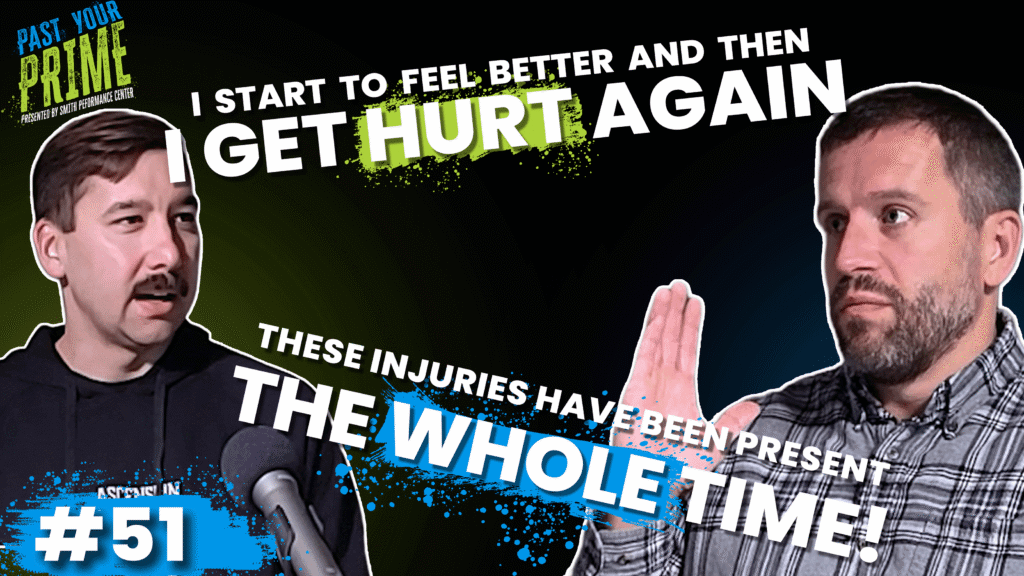

why rehab feels like chasing injuries podcast episode 51

The Takeaway

If rehab feels like you’re chasing injuries, it doesn’t mean you’re broken.

It may mean you’re finally uncovering the next layer.

And that’s not a setback.

That’s how real healing works.

🎙️ About Past Your Prime Podcast

Past Your Prime is the podcast for active adults balancing training, rehab, family, and real life.

Hosted by Craig Smith (PT & SPC Founder) and Alex Keicher (professional athlete and working dad) and presented by Smith Performance Center.

Listen & follow:
Spotify | Apple | Youtube

Related Posts

Explanation of muscle tightness and why stretching may not solve stiffness

The Myth of “Muscle Tightness” And What Actually Is

Past Your Prime Podcast – Episode 53 Listen on:Spotify | Apple | Youtube “Tightness” is one of the most common complaints people describe after pain or injury. But tightness is a description, not a diagnosis. In this episode of Past Your Prime, Craig and Alex discuss why the term “tightness” often causes confusion and why stretching is not always the solution people think it is. Using examples like hamstring tightness, the conversation breaks down what may actually be happening in the body. Instead of assuming muscles are simply short or inflexible, this episode explores the different systems that influence mobility and movement. Topics include: If you have ever felt stiff, tight, or restricted and wondered what your body is actually telling you, this episode explains why stretching alone often misses the real problem. If you enjoy this episode, you can learn more about the causes of tightness in our article “Why Your Hamstrings Always

Read More »
Craig Smith discussing how the body must handle peak stress for returning to sports as an adult on the Past Your Prime podcast episode 52.

Returning to Sports as an Adult: Why It Keeps Falling Apart

Past Your Prime Podcast – Episode 52 Listen on:Spotify | Apple | Youtube Returning to sports as an adult often feels harder than it should. You finally get back into basketball, volleyball, running, or lifting. Things go well for a few weeks or months. Then something breaks down. A knee flares up. The calf tightens. The shoulder starts barking. Eventually you stop again. Then the cycle repeats. Most people assume this happens because they are getting older or because their body is fragile. But the reality is usually much simpler. Most people restart their sport without adjusting the standard they use for returning. They return using the same assumptions they had when they were 21. This episode of Past Your Prime breaks down why this happens and how to approach sports in a way that allows you to keep playing long-term instead of constantly restarting. The “Big Three” Problems With Returning To Sports As

Read More »
Explanation of muscle tightness and why stretching may not solve stiffness

The Myth of “Muscle Tightness” And What Actually Is

Past Your Prime Podcast – Episode 53 Listen on:Spotify | Apple | Youtube “Tightness” is one of the most common complaints people describe after pain or injury. But tightness is a description, not a diagnosis. In this episode of Past Your Prime, Craig and Alex discuss why the term “tightness” often causes confusion and why stretching is not always the solution people think it is. Using examples like hamstring tightness, the conversation breaks down what may actually be happening in the body. Instead of assuming muscles are simply short or inflexible, this episode explores the different systems that influence mobility and movement. Topics include: If you have ever felt stiff, tight, or restricted and wondered what your body is actually telling you, this episode explains why stretching alone often misses the real problem. If you enjoy this episode, you can learn more about the causes of tightness in our article “Why Your Hamstrings Always

Read More »
Craig Smith discussing how the body must handle peak stress for returning to sports as an adult on the Past Your Prime podcast episode 52.

Returning to Sports as an Adult: Why It Keeps Falling Apart

Past Your Prime Podcast – Episode 52 Listen on:Spotify | Apple | Youtube Returning to sports as an adult often feels harder than it should. You finally get back into basketball, volleyball, running, or lifting. Things go well for a few weeks or months. Then something breaks down. A knee flares up. The calf tightens. The shoulder starts barking. Eventually you stop again. Then the cycle repeats. Most people assume this happens because they are getting older or because their body is fragile. But the reality is usually much simpler. Most people restart their sport without adjusting the standard they use for returning. They return using the same assumptions they had when they were 21. This episode of Past Your Prime breaks down why this happens and how to approach sports in a way that allows you to keep playing long-term instead of constantly restarting. The “Big Three” Problems With Returning To Sports As

Read More »