Updated by Craig Smith July/24/2026
Strength training for triathletes should make swimming, cycling, and running more sustainable. It should not leave you so sore or fatigued that the quality of your primary training suffers.
That is where many triathletes struggle. They already have to fit three disciplines into a busy schedule, and adding strength training can feel like adding another sport. The solution is not simply to do more—it is to build a foundation that addresses the stresses created by training and competing.
A well-designed strength program must fit within your current capacity while gradually expanding it. This requires accounting for your injury history, physical abilities, available energy, and total training load. When those factors are considered together, strength training can help you perform better, manage recurring problems, and remain active in the sport longer.

If you are struggling with an injury as a triathlete, you can read our case study Triathlon Injury Rehab: How SPC Phases Prevent Setbacks and learn how to develop a rehab plan.
How Can Strength Training Help a Triathlete?
Triathlon training creates an unusual combination of demands. Swimming, cycling, and running require different skills, but the stress and adaptations from each discipline accumulate within the same person. The adaptations developed through one discipline can also affect performance in another.
For example, some triathletes develop movement strategies in which the hamstrings or adductors compensate for reduced gluteal contribution. This may present as cramping, altered mechanics, or declining performance as fatigue develops.
When additional training reinforces a limiting movement strategy, doing more can actually reduce performance instead of improving it.
Beyond addressing these limiting adaptations, strength training can improve your ability to produce force and tolerate repetitive loading. Research has found that heavy strength training, plyometric training, and programs combining different strength methods can improve running economy. Strength training may also improve cycling performance and exercise economy, particularly during prolonged efforts when fatigue begins to affect performance.
However, strength training is not automatically helpful.
A poorly designed program can add fatigue, aggravate an existing injury, or reduce the quality of important swim, bike, and run sessions. The value of strength training depends on how well it fits into the rest of your training and whether it addresses the limiting adaptations that arise from repeated swim, bike, and run training.
The Goal Is to Build Capacity, Not Just Add Exercise
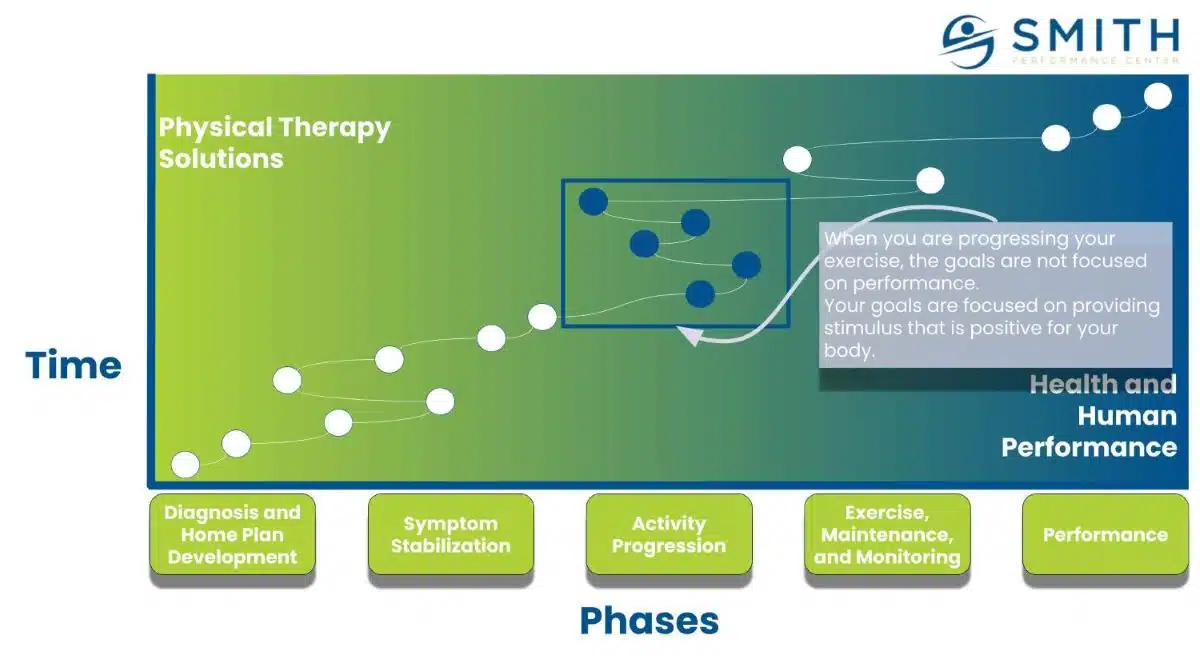
Every workout applies stress to multiple systems at the same time. At Smith Performance Center, we organize these demands into three interconnected capacities: physical capacity, tissue capacity, and energy capacity.
Physical capacity includes your strength, endurance, coordination, movement skills, and ability to perform the activity. Strength training directly develops many of these qualities.
Tissue capacity describes how well your muscles, tendons, bones, joints, and nervous system tolerate mechanical stress. A triathlete may have the fitness to complete a workout while a specific tissue—such as an Achilles tendon, knee, or bone—does not currently tolerate the load.
Energy capacity includes the resources needed to train, recover, and adapt. Nutrition, sleep, illness, work demands, psychological stress, and the total volume of exercise all influence this capacity.
If you are not sure how energy capacity can impact tissue capacity, read more about the interaction in our article Why Runners Keep Getting Shin Pain and Stress Fractures
These capacities do not operate independently. A strength workout can improve physical capacity while also loading tissues and consuming energy needed for recovery. The program works when the training stress is high enough to create adaptation but not so high that it overwhelms one of the other capacities.
How Often Should Triathletes Strength Train?
Most triathletes can start with one or two strength sessions per week. The correct frequency depends on the athlete’s experience, current training phase, injury history, schedule, and recovery.
Two sessions per week may work well during an off-season or general preparation phase. One session may be enough for a beginner, an athlete entering a high-volume build, or someone trying to maintain strength during the competitive season. A third session may occasionally be appropriate, but it should not be added automatically.
More is not necessarily better.
If strength training consistently reduces the quality of your key endurance sessions, causes prolonged soreness, or produces worsening pain, the total dose needs to be reconsidered.
What Should a Triathlon Strength Program Include?
A triathlon strength program does not need to mimic swimming, cycling, or running. Performing a swimming motion against a resistance band does not necessarily make the exercise more specific or more effective.
The sport itself provides the most specific practice. If you need to improve your swimming technique, you need to swim. Strength training should develop qualities that support your ability to practice and perform the sport.
A well-rounded program will usually include several of the following movement categories:
- Lower-extremity push
- Lower-extremity pull
- Split-leg movement
- Upper-extremity pull
- Upper-extremity push
- Core and trunk control
- Sport-specific additions (e.g., calf and ankle strengthening, power or plyometric work when appropriate)
The exact exercises matter less than whether they are appropriate for the athlete and can be progressed consistently. A sit-to-stand may be a better choice than a squat for one athlete, while another may benefit from split squats, deadlifts, or step-ups.
How Heavy Should Triathletes Lift?
Triathletes do not have to perform endless repetitions with light weights simply because their sport involves endurance. The endurance stimulus is already being provided by swimming, cycling, and running.
A new strength program may begin with moderate loads and sets of approximately 6–12 repetitions while the athlete learns the exercises and develops tolerance. Over time, some primary exercises can progress toward heavier loads performed for approximately 3–6 repetitions. Accessory exercises may remain in moderate or higher repetition ranges.
A typical workout might contain three to five primary exercises performed for two to four working sets. The athlete should generally finish most sets before technique breaks down or complete muscular failure occurs. This keeps the focus on developing strength without creating unnecessary fatigue.
Plyometric exercises can also improve force production and running economy, but they add mechanical stress. Hopping, jumping, and bounding should be introduced based on the athlete’s existing running volume, injury history, and tissue tolerance—not simply because they appear on a list of recommended triathlon exercises.
A Simple Two-Day Strength Framework
The following is a general framework rather than an individualized program:
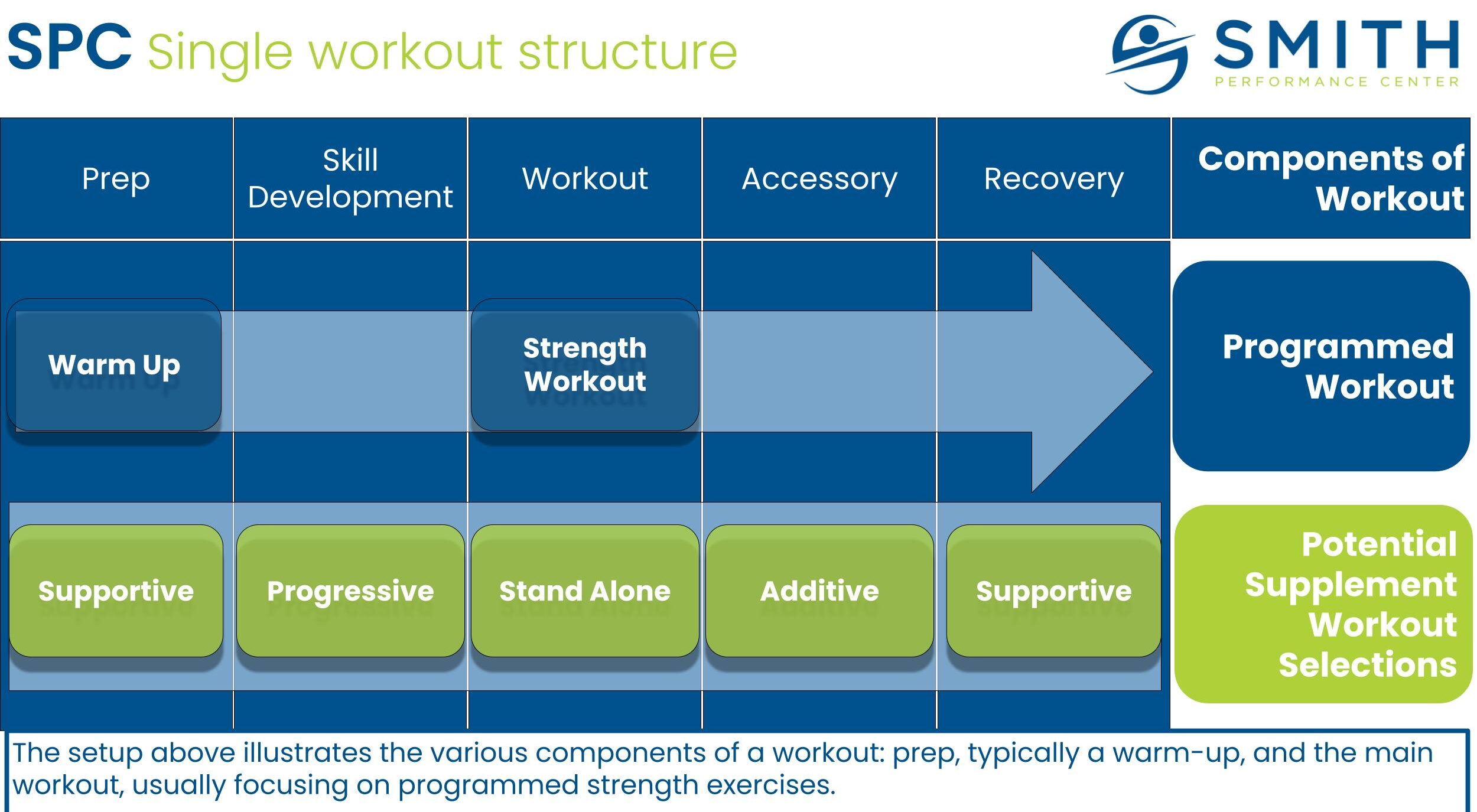
| Movement category | Day 1 | Day 2 |
|---|---|---|
| Lower-extremity press | Squat or sit-to-stand | |
| Lower-extremity pull | Trap-bar deadlift or band deadlift | |
| Upper-extremity pull | Row or pulldown | |
| Upper-extremity push | Push-up or dumbbell bench press | |
| Targeted lower-extremity strengthening | Single-leg calf raise or glute-focused exercise | Lunge or single-leg squat |
| Core | Plank | Suitcase carry |
| Optional addition | Low-volume plyometric | Upper-body accessory |
Each session should be short enough that it can be performed consistently without compromising the rest of the training week. For many triathletes, 30–45 minutes of focused strength training is more useful than a long workout containing numerous corrective exercises.
Exercises can be changed when there is a clear reason, but constant variation makes progression difficult to measure. Keep the program simple, track the loads and repetitions, and allow enough time for adaptation.
How Should Strength Training Fit Around Swimming, Cycling, and Running?
There is no perfect weekly schedule that works for every triathlete. The priority is to protect the quality of the most important training sessions while providing enough recovery between stressful workouts.
Avoid introducing a new or high-volume strength workout immediately before a long run, hard cycling session, or important race-specific workout. When strength and endurance training occur on the same day, separating the sessions by several hours may help when the schedule allows.
Some athletes place strength training after a harder endurance session to keep hard training on the same day and preserve easier recovery days. Others perform strength training before endurance work when strength development is the priority. The best arrangement is the one that allows the athlete to complete both sessions with acceptable quality and recover before the next important workout.
The schedule should also change across the season. Strength volume may be higher during general preparation and reduced as race-specific training increases. Maintaining strength usually requires less work than initially developing it.
Don’t forget to think about your fitness and fatigue can be used for optimizing your program. You read more about this idea in our article Maximize Your Season: Structuring Endurance & Strength Training with Three Key Questions.
Start With Your Injury History
Previous injury is one of the most useful pieces of information when designing a program. It does not guarantee another injury, but it can identify tissues, movements, and training situations that deserve closer monitoring.
An athlete with a history of tibial bone stress injury needs a different progression than an athlete with recurring shoulder pain. Someone with a history of Achilles tendinopathy may tolerate cycling volume well but struggle when running mileage, hills, plyometric training, and heavy calf work increase at the same time.
Your injury history should influence exercise selection, starting load, progression, and the signs you monitor. It should not be treated as an irrelevant event that ended when the pain disappeared.
Another term for this is developing a body inventory. You can listen to our deep dive into the body inventory on our podcast, Past Your Prime.
Establish Key Signs Before Increasing Training
At SPC, we use the term key sign to describe a repeatable finding that helps monitor a problem. A key sign may be a symptom, movement, strength test, functional task, or predictable response to training.
For an athlete with a history of low back pain and neural sensitivity, a key sign might be increased morning stiffness or a loss of tolerance during a specific movement. For someone with an Achilles problem, it might be pain during the first few steps in the morning or a change in single-leg calf-raise performance.
The goal is to identify a change before the problem becomes severe enough to stop training. A key sign does not diagnose the problem by itself, but it gives the athlete and clinical team a consistent way to judge the response to training.
We use a simple process:
Baseline → Action → Response → Reassess
First, establish the athlete’s normal baseline. Next, perform the planned workout or training progression. Monitor the immediate and delayed response, then use that information to decide whether to maintain, progress, or modify the program.
If you have an injury, we need to address it before focusing on strength training. You can read more about how a rehab plan for a triathlete looks at SPC in our article Triathlon Injury Rehab: How SPC Phases Prevent Setbacks.
Strength Training Cannot Guarantee That You Will Avoid Injury
No program can eliminate every injury. Training exposure, previous injuries, recovery, health, competition, accidents, and numerous other factors all influence injury risk.
Strength training can reduce certain injury risks and improve an athlete’s ability to tolerate load, but it should not be presented as a guarantee. The more realistic goal is to reduce avoidable problems, recognize emerging injuries quickly, and prevent a manageable issue from becoming a major interruption.
If a key sign worsens, pain begins changing technique, or symptoms continue escalating across several workouts, simply pushing through is not a plan. The athlete may need a temporary load modification, an alternative exercise, a training aid, or a physical therapy assessment to determine what is driving the problem.
Monitor Energy Capacity and Fueling
Triathletes have high energy demands before strength training is even added. Inadequate fueling can impair recovery, reduce training quality, and contribute to declining health and performance.
Persistent fatigue does not automatically mean you need to eat more. Sleep disruption, illness, iron deficiency, excessive training stress, and outside life demands can create similar symptoms. However, low energy availability should be considered when fatigue is accompanied by declining performance, recurrent bone stress injuries, frequent illness, menstrual changes, impaired recovery, or persistent difficulty completing normal training.
Strength training creates another demand that must be fueled. A dietitian can help determine whether carbohydrate intake supports training, protein is distributed appropriately, and total intake matches the athlete’s goals and workload.
Watch the Response to the Entire Training Week
Triathletes often judge workouts individually: the run went well, the strength session felt fine, and the bike was completed as planned. The more important question is how the combination affected the athlete over several days.
A workout that appears appropriate on its own may become excessive when placed next to a long run, high-intensity bike session, poor sleep, and a stressful week at work. The body experiences the combined load, not the training plan as separate boxes on a calendar.
Monitor performance, symptoms, soreness, motivation, sleep, appetite, and the response of established key signs. One difficult workout is not necessarily a problem, but a progressively worsening pattern deserves attention.
Use a Long-Term Approach
Triathletes are usually not lacking motivation. The greater problem is trying to fit too much training into a limited amount of time and energy.
Strength training should support years of swimming, cycling, and running—not merely prepare you for the next race. This requires a foundation phase, gradual progression, maintenance during demanding periods, and appropriate changes when your health, schedule, or goals change.
The best program is not the most complicated one. It is the program you can perform consistently, recover from, and progress without sacrificing the activities you are trying to improve.
Start With a Movement Assessment at Smith Performance Center
At Smith Performance Center, physical therapists, strength coaches, and dietitians work together to help athletes manage the demands of training. We examine physical, tissue, and energy capacity rather than treating strength, injury, and fueling as unrelated issues.
A successful strength program begins with understanding your current capacity. During an SPC Movement Assessment, we review your goals and injury history, assess your foundational movement patterns, and identify physical limitations that may be affecting your training.
From there, our strength coaches build a program that fits around your swimming, cycling, and running. If pain or an active injury is affecting your movement, our physical therapists can determine whether it should be addressed before or alongside strength training. When fueling, fatigue, or recovery is limiting progress, our dietitian can help address the energy demands of your training.
The goal is not simply to add more exercise. It is to establish the right starting point and build the capacity to train, compete, and remain active with confidence.
Schedule your Movement Assessment and start building a stronger foundation for your training.